
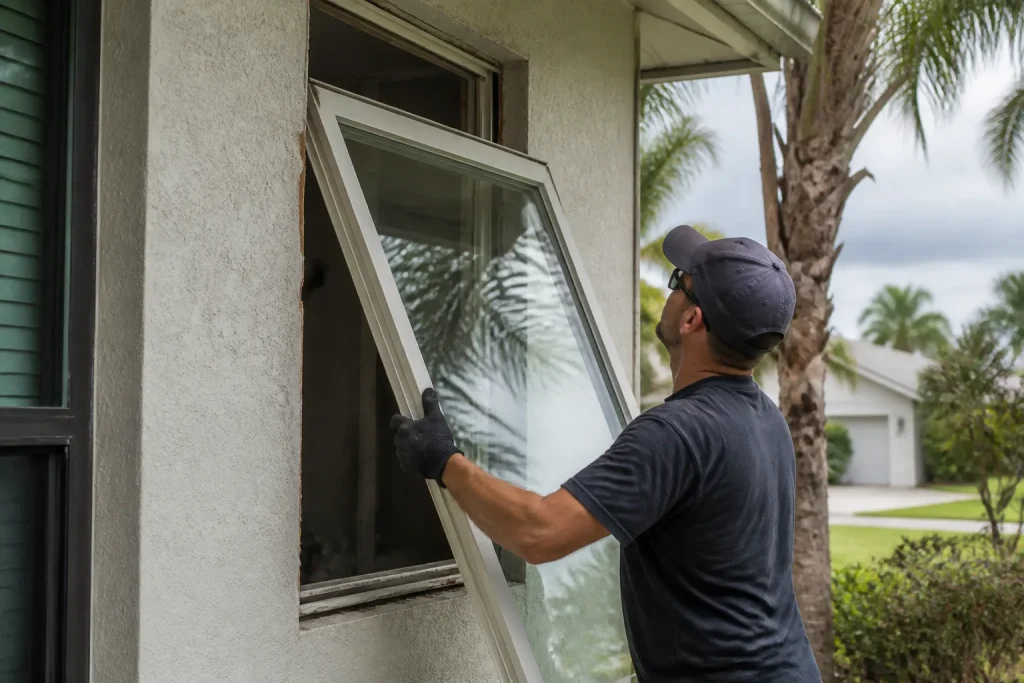
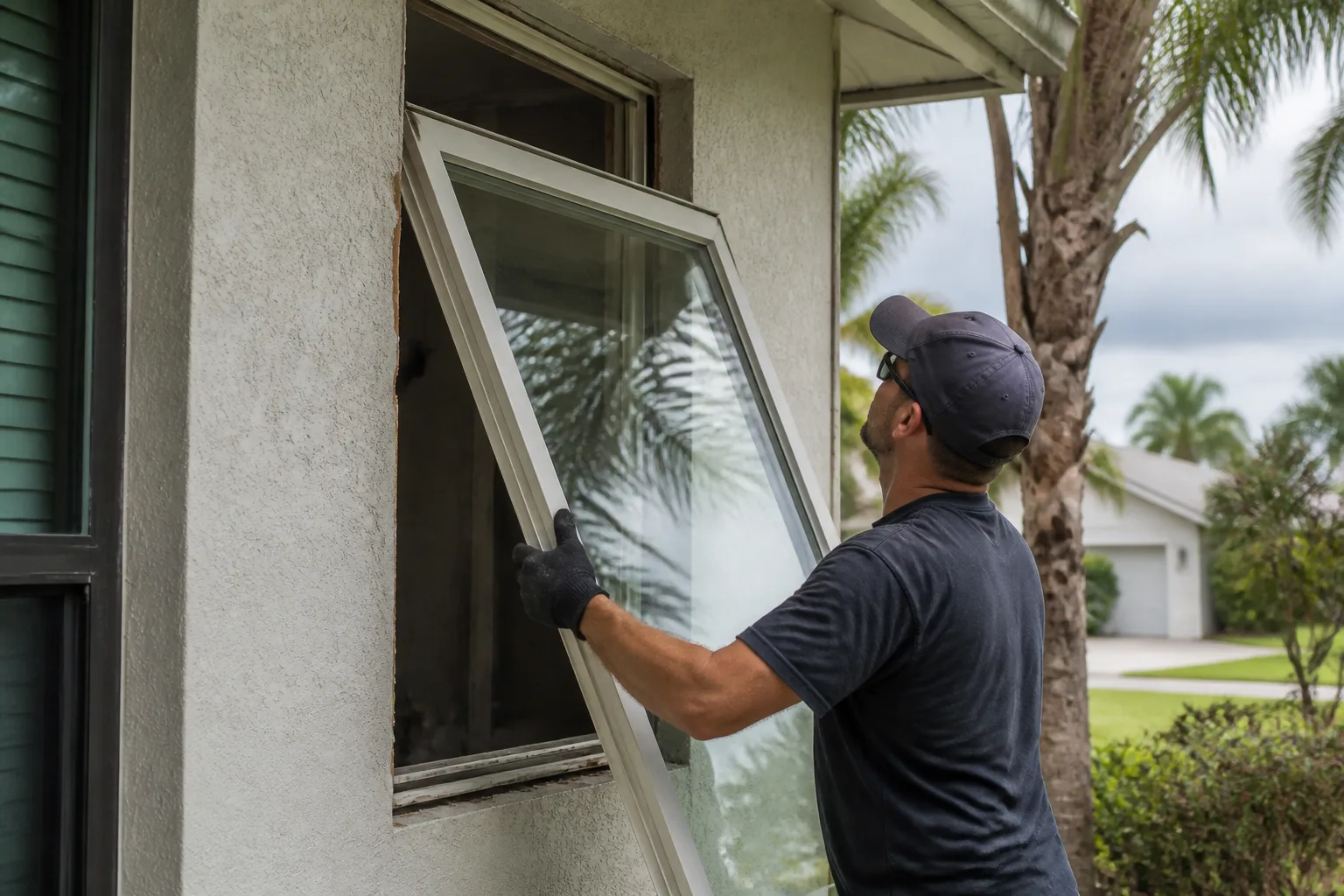
Emergency Window Installation Near Me: What Tampa Homeowners Should Do First
A broken window in Tampa during a rain event lets in roughly a gallon of water per minute at wind speeds above 25 mph. The insurance adjuster will ask what you did in the first hour, and “I searched for a contractor” is not a useful answer. Emergency window installation in Tampa starts with stopping the damage, documenting everything, and then calling a licensed installer who can give you something in writing before the first pane comes out. If you’d rather not handle the temporary work yourself, call TruePane Windows & Doors at (813) 320-9346 and a live person will answer, day or night.
The first thirty minutes after a window fails set the ceiling on how much water, mold, and liability exposure you’ll carry before a permanent fix is possible. Most Tampa homeowners spend that window making calls instead of stopping the damage. This guide sequences the immediate actions correctly so that by the time an installer arrives, the situation hasn’t gotten materially worse.
What to Do in the First Ten Minutes After a Window Fails
Before you call anyone, do three things in order. First, clear the immediate area of people and pets. Broken glass travels further than you think, especially laminate fragments scattered by a wind gust off Tampa Bay. Second, shut interior doors to isolate the room. This limits water migration, slows airflow that turns a small leak into a pressurized spray, and keeps broken glass from tracking through the house. Third, assess whether the window opening itself looks structurally compromised. If the frame is visibly racked, the header is sagging, or the surrounding drywall is cracking away from the opening, keep everyone out of the room entirely until a professional assesses the frame. A failed seal is an inconvenience; a shifted header is a structural event that gets worse when someone leans on it.
Once the room is clear, photograph everything. We mean this literally: photograph the broken window from at least three angles, capture the floor and sill area before you move a single piece of glass, and photograph any water that has already entered. Florida property damage claims under rule 69B-220.051 require documented proof of mitigation, and adjusters routinely deny claims where the homeowner can’t show what the opening looked like before cleanup began. Use your phone’s timestamp setting. Those photos are your record of reasonable mitigation.
The Correct Temporary Boarding Sequence for Tampa Homes
The order matters more than most people think. Under Florida’s building code and standard insurer expectations, temporary boarding goes on the exterior of the opening first, not the interior. Exterior boarding sheds the majority of wind-driven rain before it reaches the frame and rough opening. Interior boarding alone can trap moisture inside the wall cavity, which is how a one-night window failure becomes a three-month mold remediation. We’ve pulled interior-only plywood off openings in Carrollwood where the stud cavities were wet to the touch because the homeowner sealed the water in, not out.
For the exterior layer, use 5/8-inch CDX plywood, not OSB. OSB swells and delaminates when soaked, which is what it will be in a Tampa storm. Cut the plywood two inches larger than the rough opening on every side, secure it with 1-1/2 inch exterior deck screws into the framing or window buck at no more than twelve inches on center, and tape the top edge with a flashing-grade tape like Vycor. Do not use interior drywall screws; they rust and lose grip within days. If the window is on a second floor, don’t get on a ladder during a storm. Put an interior piece over the opening to slow water, place towels at the sill, and call a professional. Ladder work in wind is how broken windows become broken homeowners.
This is also the time to kill power to the room if water is reaching outlets or light fixtures. Water and live wiring make the emergency worse by a factor of ten, and the adjuster’s liability conversation changes entirely if someone gets hurt after the fact.
Materials insurers accept as reasonable mitigation:
- 5/8-inch CDX plywood cut to oversize the opening
- 1-1/2 inch exterior deck screws (not drywall screws, not nails)
- Flashing tape over the top seam
- Interior plastic sheeting as a secondary barrier
- Towels or absorbent cloths at the sill, replaced regularly
Materials that complicate claims:
- Interior-only boarding on an exterior breach
- OSB sheathing that disintegrates in rain
- Cardboard or particle board held on with duct tape
- Any repair attempt using construction adhesive or spray foam as a primary seal
Photograph and Document Before You Touch Anything Else
Everything in this step protects your claim. Under Florida’s property damage rules, the insurer evaluates whether the homeowner took reasonable steps to prevent additional loss. That evaluation is only as good as the record you build in the first hour. Photograph the exterior of the home before boarding. Photograph the interior floor, sill, and wall surfaces around the opening. Photograph any framing, flashing, or weatherstripping that appears to have failed before the glass broke, because a pre-existing defect changes the claim’s direction entirely. Then keep every receipt for plywood, screws, tape, and any hotel stay if the room is unusable. Even a ten-dollar box of screws is a reimbursable mitigation line item when documented properly.
Write down the timeline. When did the window fail? What was the weather doing? What did you do in what order, and at what time? The adjuster is not going to ask you to recite this from memory on the spot, but having it written down before memory softens is the difference between a coherent claim and a vague one. We’ve stood in damage rooms with homeowners in Westchase and South Tampa who had every receipt and every photo in a folder, and we’ve stood in others where the only photo was a blurry shot taken after the glass was already swept up. The first group settled faster. Every time.
If the window failure came from a forced entry or burglary, do not clean anything until the Tampa Police Department has taken a report. Call TPD first if there’s any sign of entry, then photograph, then board. The officer will document what they document, but your own photos are still the primary evidence for the insurer.
Board-Up Service vs. Emergency Installation: Know Who Does What
Here is where Tampa homeowners get burned. A board-up service and an emergency installation service are not the same thing, and conflating them leads to expensive assumptions about who does what. A board-up contractor secures the opening with plywood and leaves. That’s the whole job. They may not carry a glazing license, they may not be an authorized installer for any window manufacturer, and they may not be able to order the replacement unit that matches your existing frame. An emergency installation service measures the opening, orders or pulls the correct replacement from their inventory, installs the new window, sets it true, and registers the warranty layers before leaving. The board-up is temporary. The installation is permanent.
Here’s the trap. Some homeowners assume the board-up contractor will also handle the permanent replacement, and the contractor lets them assume that. Then a week later the homeowner finds out the board-up crew never handled windows at all, and the permanent installer arrives to find a rough opening that was never properly measured, a frame that shifted because the boarding was sloppy, and a homeowner who paid twice for work that should have been coordinated once. Before you hire anyone for emergency work in Tampa, ask one question: “Do you handle the permanent replacement window, or do you board up and refer the install?” If they do not install the replacement themselves, get the name of who will before you sign anything.
An authorized installer for manufacturer lines like PGT and CGI can often handle both the emergency stabilization and the permanent replacement, which keeps the responsibility in one set of hands. That matters when the next storm comes and a shift in the rough opening means the new window was never quite square to begin with.
What a Legitimate Emergency Installer Provides in Writing Before Starting Work
Even under time pressure, a legitimate emergency window installer in Tampa will put certain things on paper before the first pane comes out. If they won’t, that’s the signal to call someone else. At minimum, you should see a written scope that states exactly which window or door opening is being stabilized and replaced, the manufacturer and model of the replacement unit, and the total price for the emergency work. No verbal commitments. A legitimate installer will also tell you how they’re handling both warranty layers: the manufacturer’s warranty on the replacement unit and the installer’s own workmanship guarantee. At TruePane Windows & Doors home, we call this The Keystone Standard: both manufacturer warranty layers are registered in writing, with durations stated, before our truck leaves the driveway. That’s baseline.
You should also see a line about permits. For permanent window replacement in Tampa, a permit is required, and the installer should be the one pulling it. If the answer is “we’ll figure out permits later,” the answer should be no. Unpermitted window replacements become a problem when you sell the house, renew your wind mitigation inspection, or file a future claim, and the installers who wink at permits are never the ones still answering the phone when that problem lands.
Finally, confirm the replacement window meets Florida’s current building code for impact resistance if the damaged unit was in a wind-borne debris region. Most of Tampa is. PGT and CGI both make impact-rated units that meet the Miami-Dade standard, and an installer who quotes you a non-impact replacement for an impact opening, just to save a few hundred dollars, is doing you a disservice that compounds with every storm season.
One more thing we see in Tampa a lot: a homeowner who says yes to an emergency crew without checking whether the company actually exists the next week. Before the work starts, write down the company’s license number, the name of the person on-site, and the phone number on the truck. Call it while they’re standing there if you want to confirm it rings. The legitimate shops answer; the fly-by-night crews watch their own hands get busy. For related replacement work, see our pages on Window Installation in Acacia Villas and Window Replacement in Acacia Villas.
How Much Does Emergency Window Replacement Cost in Tampa?
Emergency window replacement in Tampa typically runs between $450 and $1,200 per opening for a standard single-family residential window, including the emergency service charge, removal, and a code-compliant replacement unit. A temporary board-up alone costs $150 to $350. Impact-rated replacement windows, which are required in many parts of the city, add $200 to $500 per unit depending on the size and manufacturer line. Here is a realistic breakdown:
- Emergency board-up only: $150-$350
- Standard replacement window, installed: $450-$850
- Impact-rated replacement (PGT, CGI, CWS): $650-$1,200
- Structural frame repair (if needed): $200-$800 additional, assessed on site
Any installer asking for full payment before the window is in the opening, set true, and cleaned up is not following the standard sequence. A legitimate Tampa installer takes a deposit for the emergency call-out and materials, then collects the balance when the work is done. Avoid financing pressure on an emergency. Pay for the work, file the claim, and let the insurer reimburse you. The homeowners who go wrong on emergency window work are always the ones who rushed the hire, skipped the documentation, and paid in cash for a verbal promise. You can always compare our Door Installation in Acacia Villas standards, too; the same rules apply.
The Bottom Line
The first hour after a Tampa window fails is mostly about paperwork and moisture control, not about scrolling for the cheapest quote. Isolate the room, photograph everything, board the opening from the outside with plywood and deck screws, and make sure the installer who arrives with the permanent window hands you a written scope and warranty registration before they touch the opening. If the pane is not true, the job is not done. If you’re in Tampa and need emergency window installation or a board-up followed by a permanent replacement, TruePane Windows & Doors offers free estimates, written line-item pricing, and a live person on the phone 24/7. Call (813) 320-9346.
Frequently Asked Questions
Clear people and pets from the room, shut the door to isolate the area, photograph the damage from multiple angles before moving anything, and kill power to the room if water is reaching outlets. Then board the opening from the outside with 5/8-inch CDX plywood and deck screws. Don’t wait to start this while you call around; insurance adjusters look for documented mitigation. Call (813) 320-9346 once the immediate damage is contained and we’ll help you sequence the permanent fix.
Most Florida homeowners policies cover sudden accidental window breakage and storm damage, less your hurricane or all-peril deductible, but only if you can demonstrate reasonable mitigation. That means photos taken before cleanup, receipts for boarding materials, and a written record of what you did and when. Pre-existing frame rot or failed seals are typically not covered. Call (813) 320-9346 if you want help understanding what your scene looks like from an adjuster’s perspective; we’ve worked enough Tampa claims to know what gets denied and why.
You can, and most Tampa homeowners should handle the temporary boarding themselves if conditions are safe. But do not let the temporary board become a semi-permanent fix. A boarded opening lets in humidity, pests, and eventually water around the plywood edges. The longer the opening sits boarded, the more likely the rough opening shifts, the studs pick up moisture, and the replacement window goes in less true than the original. In our experience, a week is about the maximum for an unsealed board-up in Tampa’s humidity before the risks compound. For permanent replacement, call (813) 320-9346.
Look at the header above the opening. If it is sagging, if the drywall around the opening is cracked or pulling away, or if the frame shifts when you press on it, the structure is compromised and the opening needs a professional assessment before a new window goes in. Laminated glass that spider-webbed but held its shape usually means the frame did its job. A frame that moved under the glass is a different, more serious problem. We will tell you honestly which one you have; call (813) 320-9346 for a straight read on your opening.
Written by Dale Kessler, Owner at TruePane Windows & Doors, serving Tampa since 2008.
Need Windows & Doors Help?
Call TruePane Windows & Doors - licensed & insured, here with fast after-hours help in Tampa.
(813) 320-9346